
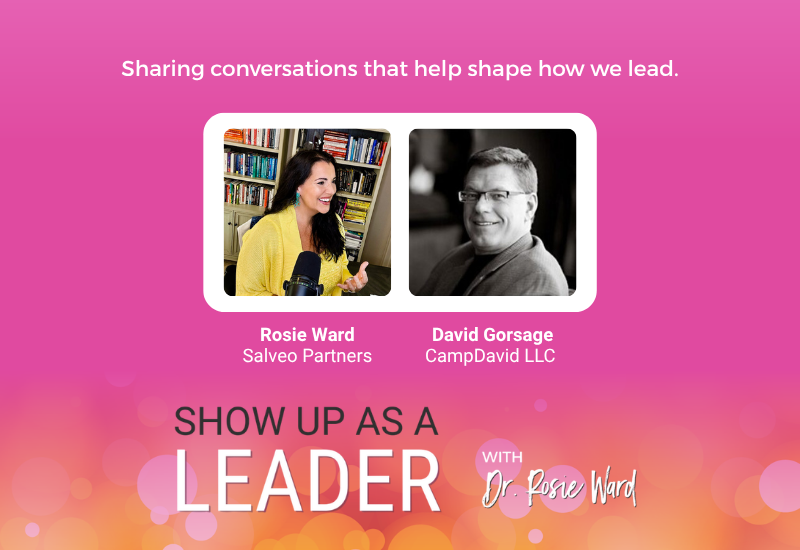
Some conversations stay with me because they challenge the way we think about leadership. My conversation with performance coach and leadership development expert David Gorsage did exactly that.
David opened with a provocative idea: in a world moving this fast, “good to great” is no longer enough. But what I appreciated most was that his definition of extraordinary had nothing to do with being superhuman, doing more, or chasing some impossible standard.
It starts with becoming a better version of ourselves, one interaction and one intentional step at a time.
That landed with me because it is so aligned with how I think about leadership. Leadership is not a title. It is how we maximize our positive impact by becoming our best, fully authentic selves and helping others break past barriers so they can step into their greatness.
And David’s message was a powerful reminder that the path to extraordinary is not “out there.” It starts inside us.
Extraordinary Starts With the Inner Game
One of the first frameworks David shared was what he calls the performance triangle: behavior, skills and knowledge, and mindset.
Most of us are conditioned to focus on the first two. We ask: What do I need to do differently? What skill do I need to learn? What knowledge am I missing?
Those things matter. But, as David pointed out, mindset sits at the apex of the triangle. And if we ignore it, it can quietly undermine everything else.
That is where the “head trash” lives.
You know the stuff. The stories we tell ourselves. The self-doubt. The old messages about who we are supposed to be. The judgments about where we are falling short. The protective patterns that may have helped us at one point but now get in the way of who we want to become.
We can keep piling on skills, tools, and tactics, but if the narrative running in the background is working against us, our performance will eventually hit a ceiling.
This is why self-leadership matters so much. Before we can consistently lead others well, we have to get curious about what is running us.
How Candid Are You With Yourself?
David said one of the first things he looks at when coaching someone is candidness. Not whether they can be candid with someone else, but whether they can be candid with themselves.
Oof. That is a different question.
It is easy to say we want to grow. It is harder to look honestly at the gap between who we want to be and how we are actually showing up.
David described that gap as the “esteem gap.” His process begins by asking people to define the ideal for an important role in their life, then name the current reality. That role might be leader, spouse, parent, friend, sibling, or something else entirely.
For example: Who do I want to be in this role? How do I want people to experience me? What is actually true right now?
That gap is not there to shame us. It gives us something useful to work with.
What I love about this approach is that it moves us away from vague self-improvement and toward deliberate practice. Instead of “I need to be a better leader,” we can identify the specific behavior, belief, or way of showing up that would move us closer to the person we want to be.
That is where change becomes tangible.
Small Practices Can Rewire the Story
David uses structured journaling to help clients start shifting the internal narrative. After defining their ideals and realities across the major roles in their lives, they create positive statements that reinforce how they want to show up and handwrite them regularly.
What stood out to me was his emphasis on making the practice realistic. He does not tell people to be perfect or commit to seven days a week. He suggests establishing a baseline and building from there.
That matters because sustainable growth is rarely about one giant breakthrough. It is about repetition.
Our brains are remarkably adaptable. We can lay down new pathways. We can interrupt old scripts. We can notice when our past wiring is trying to hijack the present and choose differently.
But it requires practice.
David shared that clients often notice measurable shifts quickly when they consistently do the work. Whether your practice is journaling, reflection, coaching, or another intentional method, the broader lesson is the same: we do not have to keep letting old head trash run the show.
Your Past Self Does Not Have to Drive
Later in our conversation, I asked David to name a self-limiting story that still shows up for him. His answer reminded me that this work never really ends.
He thinks about whether he is operating from his past self, current self, or future self. His past self can be highly demanding, intensely driven, and so focused on getting the result that he can steamroll over other people.
His work is to notice that tendency and ask whether he is bringing enough empathy to the situation in front of him.
That kind of self-awareness is leadership.
We all have versions of ourselves that can grab the wheel when we are stressed, threatened, rushed, or overly attached to an outcome. The goal is not to pretend those parts of us disappeared. The goal is to recognize them sooner so we have more choice in what happens next.
That is one of the most important parts of becoming extraordinary: not perfection, but awareness plus choice.
Extraordinary Teams Start With a Different Leadership Mindset
Once we moved from self-leadership into team leadership, David offered another idea I loved: walk into the room assuming every person has a unique piece of the puzzle.
That changes the leader’s role.
Instead of believing, “I need to have the answer,” the leader starts from, “It is my responsibility to help bring out the contribution only these people can make.”
That is a very different posture.
It requires humility. Curiosity. Trust. And a willingness to admit that the leader does not have all the answers.
It also aligns deeply with what we know about psychological safety and innovation. People are far more likely to offer ideas, challenge assumptions, and contribute their best thinking when they believe their perspective is valued and they will not be punished for speaking up.
Especially as AI and technology continue to reshape work, leaders cannot afford to waste human potential by creating environments where people hide out, hold back, or wait to be told what to do.
Our job is to help people contribute what machines cannot: perspective, judgment, creativity, empathy, connection, and meaning.
Four Questions That Can Unlock Someone’s Potential
David shared four questions he uses in one-on-one conversations to help leaders draw out what matters to people and support their growth:
- What do you want? What are you ideally trying to achieve?
- What would life or work feel like if you were operating in that reality?
- On a scale of 1 to 10, how close are you to that ideal right now?
- What is the next step I can help you take toward it?
I love these questions because they turn development into an ongoing conversation instead of something we outsource to a training department or save for an annual performance review.
Developmental moments are happening all day long. The question is whether we notice them.
When leaders consistently ask what people want, where they feel stuck, and how they can help, they communicate something powerful: I see you. I believe in you. Your growth matters here.
And that is often where people begin to see possibilities in themselves that they had not yet named.
Nurturing Curiosity Changes the Conversation
David also talked about communication patterns and the difference between coming at people from a critical, directive place versus a more nurturing one.
Many of us learned communication through “shoulds”: You should do this. You need to do that. Why did you do it that way? And without realizing it, we can carry those same patterns into leadership.
A more useful approach sounds like curiosity: Help me understand. What was important to you here? How can I support you? What are you seeing that I may be missing?
That shift creates space for honesty and vulnerability. And vulnerability has to be modeled. David shared advice from his first coach: if you want your client to be vulnerable, you have to be vulnerable first.
The same is true for leaders. If we want people to be real, we have to be willing to be real. If we want people to admit mistakes, ask for help, or name what they do not know, we have to model that first.
We set the emotional tone for what is safe.
Extraordinary Is One Step at a Time
David closed our conversation with a story about climbing Mount Everest. The point was not the summit itself. The point was the next step and what had to be overcome internally to take it.
That may be my favorite takeaway from our entire conversation.
Because “be extraordinary” can sound enormous. It can feel like one more impossible standard in a world already asking too much of us.
But one step? We can do that.
- One moment of greater candor.
- One old story challenged.
- One conversation approached with more empathy.
- One question that helps someone see their own potential.
- One choice to lead from who we want to become instead of who we have been.
That is how extraordinary leadership is built.
Not all at once. One intentional step at a time.
One Challenge for You
This week, identify one role in your life where there is a gap between how you want to show up and what is currently happening.
Then ask yourself:
- What is my ideal? How do I want people to experience me in this role?
- What is the honest current reality?
- What head trash or old pattern may be contributing to the gap?
- What is one small, specific step I can take this week to move closer to the person I want to be?
Do not try to overhaul everything. Pick one step. Practice it. Pay attention to what changes.
Want to go Deeper?
This article only captures part of my conversation with David Gorsage.
In the full episode, we dig further into his performance triangle, the role of candor and self-talk, the “esteem gap,” structured journaling, communication dynamics, vulnerability, and the practical questions leaders can use to help people move toward their potential.
If you are interested in becoming a more intentional version of yourself—and helping the people around you do the same—I encourage you to listen to the full episode of Show Up as a Leader.
👉 Listen here or wherever you get your podcasts.
A Clear Next Step
David’s message reinforces something I believe deeply: sustainable leadership growth starts on the inside. We have to notice the stories, patterns, and self-protective habits that shape how we show up before we can consistently create a different impact around us.
If you are ready to do that work, here are two ways to keep going:
- Strengthen your inner game through coaching and leadership development. At Salveo Partners, we help individuals and teams build the self-awareness, mindset, emotional agility, and human-centered leadership skills needed to navigate change, strengthen relationships, and bring out the best in themselves and others.
- Get my book, Future-Proofing Leadership. Inside, you’ll gain access to my Faulty Program Discovery to help you uncover the protective patterns that may be getting in your way, along with practical resources throughout the book to help you turn insight into action.
Because becoming future-ready is not about becoming flawless. It is about becoming more aware, more intentional, and more capable of choosing how you show up when the pressure is on.
👉 Learn more about Workshops and Coaching options with Salveo Partners.
👉 Get your copy of Future-Proofing Leadership.

