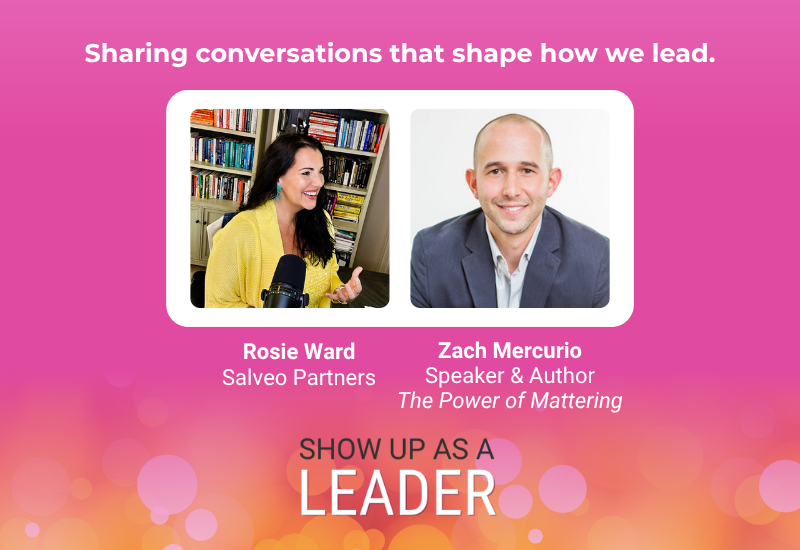
It has been one year since Zach Mercurio released The Power of Mattering, and I keep coming back to the conversation I had with him on Show Up as a Leader.
Some podcast conversations stay with you because they introduce a new idea. This one stayed with me because it gave language to something so many of us have felt, witnessed, and tried to repair for years:
People are starving to know they matter.
- Not just that they belong.
- Not just that they are included.
- Not just that they are appreciated once in a while.
But their presence, gifts, perspective, and contribution are uniquely significant.
That distinction is one of the reasons Zach’s work has resonated so deeply with me. For decades, I’ve talked about our core human need to feel seen, heard, valued, and cared for. Zach’s research gives us a clearer way to name what is often missing in our workplaces. And as he reminded us in our conversation, when we can name something, we can begin to change it.
Mattering Is More Than a Nice Idea
One of the most powerful moments in our conversation was Zach’s explanation of what it means to matter.
- Belonging is being picked for the team.
- Inclusion is being invited to play in the game.
- Mattering is knowing the team would not be complete without you.
That lands differently, doesn’t it?
Because someone can be welcomed into an organization, included in meetings, represented in programs, and still feel invisible. They can have a seat at the table and still wonder whether anyone would notice if they were gone.
And that is where we have to get honest.
Too many organizations have invested in engagement programs, recognition platforms, perks, benefits, and initiatives designed to improve the employee experience. Some of those efforts have value. But as Zach said so clearly, we cannot program or perk our way out of a mattering deficit.
Only people can value people.
Mattering doesn’t happen because we rolled out another platform. It happens in moments. It happens in interactions. It happens when someone pauses long enough to notice, affirm, and remind another human being that they are needed.
The Crisis Is Not Just Disengagement
We talk a lot about disengagement at work, and for good reason. Gallup reports that only 31% of U.S. employees and 20% of employees globally are engaged at work. Its research also shows that engaged employees have higher well-being, better retention, lower absenteeism, and higher productivity.
And the U.S. trend is moving in the wrong direction. According to Gallup data reported by HR Dive, U.S. employee engagement dropped from 36% in 2020 to 31% in 2025, representing an estimated 8 million fewer actively engaged workers over five years. The largest declines were tied to clarity around expectations and whether people feel cared about as human beings.
Workhuman’s research adds another layer: nearly 30% of workers have felt invisible at work, 27% have felt ignored, and more than half of employees feel only somewhat valued or not valued at all.
So maybe what we are calling a disengagement crisis is actually something deeper.
Maybe it is a mattering deficit.
That question matters because it changes the solution.
If we think disengagement is simply a motivation problem, we may try to fix it with incentives, perks, or performance pushes. But if the deeper issue is that people do not feel significant to the humans around them, then the solution has to be relational.
It has to be human.
And that means leadership is not just about strategy, execution, or results. Leadership is about the quality of impact we have on the people around us.
I define leadership as maximizing our positive impact by becoming our best, fully authentic selves and helping others break past barriers so they can step into their greatness. Mattering is central to that. Because people cannot fully shine when they feel replaceable, invisible, or insignificant.
This Is Why Future-Proofing Leadership Matters
This is also exactly why I wrote my book Future-Proofing Leadership.
We are living and leading through disruption, uncertainty, and constant change. And when pressure rises, our self-protective wiring gets louder. We default to control. We avoid hard conversations. We rush. We disconnect. We unintentionally make people feel like tasks to manage instead of humans to lead.
That is not because we are bad people.
It is because we are human.
But if we want future-ready organizations, we need future-ready leaders. And future-ready leaders are not the ones who have all the answers. They are the ones who can stay grounded in their humanity, build trust, create connection, and help people do their best work even when everything around them is shifting.
That is why I love that Zach’s endorsement of Future-Proofing Leadership says it is a guide for becoming the kind of leader people trust in disruptive times; one who builds cultures where people feel seen, valued, and capable of doing their best work.
That is mattering in action.
And it is not separate from business performance. It is foundational to it.
When people feel seen, valued, and needed, they are more likely to contribute, engage, trust, collaborate, innovate, and stay. When they feel invisible or replaceable, they protect themselves. They disengage. They conserve energy. They stop offering the best of themselves.
Human-centered leadership is not a “nice to have.” It is necessary.
We Have a Human Skills Gap
One of the things Zach said that stopped me in my tracks was this:
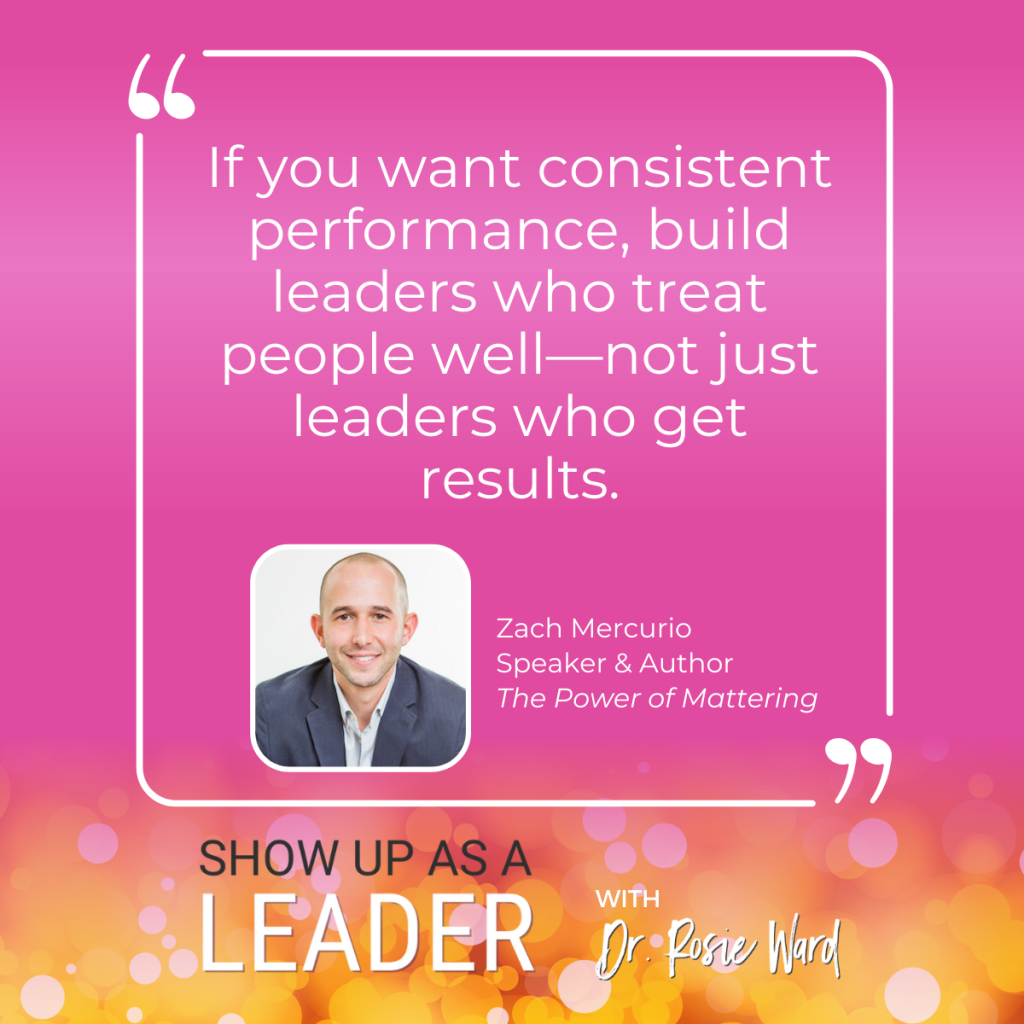
“Our ability to care for the next person we interact with has been atrophying.”
Oof!
 And yet, when you look around, it makes sense.
We are more digitally connected than ever, but that does not mean we are meaningfully connected. We can send a sad-face emoji instead of sitting with someone’s pain. We can type “Let’s catch up next week” instead of asking a real question in the moment. We can scroll, multitask, and short-circuit the awkwardness of human interaction rather than build the skills required to be present.
And those skills matter.
- Compassion is a skill.
- Listening is a skill.
- Noticing is a skill.
- Asking better questions is a skill.
- Giving meaningful recognition is a skill.
- Helping people see their impact is a skill.
For too long, we have called these “soft skills,” which has done all of us a huge disservice. There is nothing soft about the skills required to build trust, create psychological safety, have hard conversations, and help people feel seen.
These are essential skills. Power skills. Human skills.
And in a world increasingly shaped by AI, automation, and technological disruption, they are becoming more critical, not less. As Zach said in our conversation,
“AI can perform tasks. It cannot care. It cannot take moral responsibility. It cannot build trusting, accountable human relationships.”
That is our work.
Mattering Happens in Small Moments
One of my favorite parts of Zach’s framework is how practical it is. He talks about three practices that help people feel they matter: noticing, affirming, and needing.
NOTICING is about paying attention.
Not just knowing someone, but noticing the ebbs and flows of their life and work. Noticing when their energy shifts. Noticing when they seem frustrated. Noticing what they care about, what they are carrying, and what might be getting in their way.
Zach shared the story of a supervisor who kept what he now calls a “noticing notebook.” Every Friday, she wrote down one thing she wanted to remember about each person on her team. Then, the following week, she would follow up.
- “How did that meeting go?”
- “How was your vacation?”
- “Did that equipment issue get resolved?”
Small moments. Huge impact.
As one person said, there is magic in being remembered.
And let’s normalize something here: using a notebook, calendar reminder, or system to help you remember is not cheating. It is leadership. We are distracted, overloaded humans. If we care about showing up well, we need systems that support our intentions.
AFFIRMING goes beyond generic praise.
“Great job” is nice, but it usually does not stick.
Affirmation shows someone the specific gifts they bring and the specific impact they make. It helps them see what they may not see in themselves.
That might sound like:
“I noticed how you brought creativity into that conversation when things were getting tense. You helped the group find a new path forward, and the whole energy shifted because of you.”
That is very different from “Thanks for your help.”
Specific affirmation gives people evidence of their significance. It strengthens their belief that they matter.
NEEDING is about helping people understand how indispensable they are.
Not in a pressure-filled, unhealthy, “everything depends on you” kind of way. But in a human, interconnected way.
“If it weren’t for you…”
Those are powerful words.
- If it weren’t for you, this project would not have moved forward the way it did.
- If it weren’t for you, that client would not have felt so cared for.
- If it weren’t for you, this team would be missing an important perspective.
People need to know not only that they are appreciated, but that their presence makes a difference.
Leaders Cannot Rely on Good Intentions Alone
One of the big takeaways from my conversation with Zach is that good intentions are not enough.
Most leaders care more than their people know.
That is the problem.
We assume people know they matter. We assume they know we appreciate them. We assume they understand their impact. But there is often a massive gap between what we feel, what we intend, and what we actually express.
And under pressure, that gap gets bigger.
This is why we cannot rely on intuition alone. Intuition does not scale. Skills and habits do.
If we want more human workplaces, we have to build the skills, rhythms, and systems that make mattering possible. That means protecting time for real check-ins. It means asking better questions. It means reducing back-to-back chaos so leaders have the capacity to actually lead. It means rewarding people not only for what they achieve, but also for how they treat people along the way.
Because what we reward is what we become.
If we keep promoting people who deliver results while leaving damage in their wake, we should not be surprised when our cultures feel transactional, fearful, or depleted.
Human energy is the leading indicator of so many outcomes we say we care about. If leaders extract that energy rather than regenerate it, the results may look good for a while, but it is not sustainable.
The Next Interaction Matters
We often talk about culture as if it were this big, abstract thing. But culture is built in the next meeting. The next check-in. The next moment of feedback. The next time someone walks into the room, we either notice them or don’t. The next time someone shares an idea, we either dismiss it or get curious. The next time someone returns after being gone, we either make them feel replaceable or remind them why they were missed.
This work is not about being perfect.
It is about being intentional.
It is about remembering that how we show up in the next interaction matters.
A Question Worth Asking
When I asked Zach what one behavior he would challenge leaders everywhere to practice, his answer was beautifully simple:
Ask the people you lead, “When you feel that you matter to me, what am I doing?”
Then do more of those things.
That question is worth sitting with.
It is also worth asking at home, with friends, colleagues, and anyone whose life we have the opportunity to impact.
Because mattering is not just a workplace issue. It is a human issue.
And one year after The Power of Mattering was released, I am even more convinced that this work is essential for the future of leadership. If you haven’t read it, you can get Zach’s book here.
People do not need more performative appreciation.
- They need to be seen.
- They need to be heard.
- They need to be valued.
- They need to know they are needed.
And we each have the opportunity, and the responsibility, to create those moments for the humans around us.
One Challenge for You
This week, I challenge you to practice Zach’s three simple but powerful behaviors:
- Notice: Pay attention to something specific about someone’s energy, effort, or experience.
- Affirm: Name a strength or contribution in a meaningful, specific way.
- Need: Help them see how their presence and contribution make a difference.
Mattering does not require a grand gesture. It requires intention. It requires presence. And it requires us to stop assuming people know they matter and start making sure they do.
Want to Go Deeper?
This article only scratches the surface of my conversation with Zach Mercurio.
In the full episode, we explore what it really means to matter, why so many people feel invisible at work, and how leaders can create everyday moments that help people feel seen, valued, and needed.
Zach also shares practical ways leaders can build mattering into their interactions, teams, and cultures, without turning it into another program, perk, or performative initiative.
If you care about creating a workplace where people can bring more of themselves, contribute more fully, and know their presence makes a difference, I invite you to listen to the full episode.
A Clear Next Step: Transform How You Lead
Knowing that people need to matter is one thing. Building the habits, skills, and systems to lead that way consistently is another. If you want to become better at showing others they matter, here are two things that can help:
Equip your leaders with tangible human-centric skills. At Salveo Partners, we help leaders move beyond good intentions and strengthen the self-awareness, emotional agility, and human-centered leadership skills needed to create cultures where people feel seen, heard, valued, and cared for.
Through group workshops and individual coaching, leaders learn to slow down, notice their impact, navigate hard conversations, build trust, and lead in ways that bring out the best in others – even amid pressure, uncertainty, and change.
I invite you to get my book, Future-Proofing Leadership. Inside, you’ll gain access to my Faulty Program Discovery, a powerful tool to help you uncover what might be getting in your way as a leader. You’ll also find free resources with every chapter to help you put the concepts into practice.
👉 Learn more about Workshops and Coaching options with Salveo Partners.
👉 Get your copy of Future-Proofing Leadership.
Because future-proofing leadership is not about having all the answers. It is about becoming the kind of leader people can trust, follow, and grow with. If you are ready to transform how you lead, Salveo Partners can help.
Stay brave. Stay human. Stay safe. And never dull your sparkle!
Rosie
