
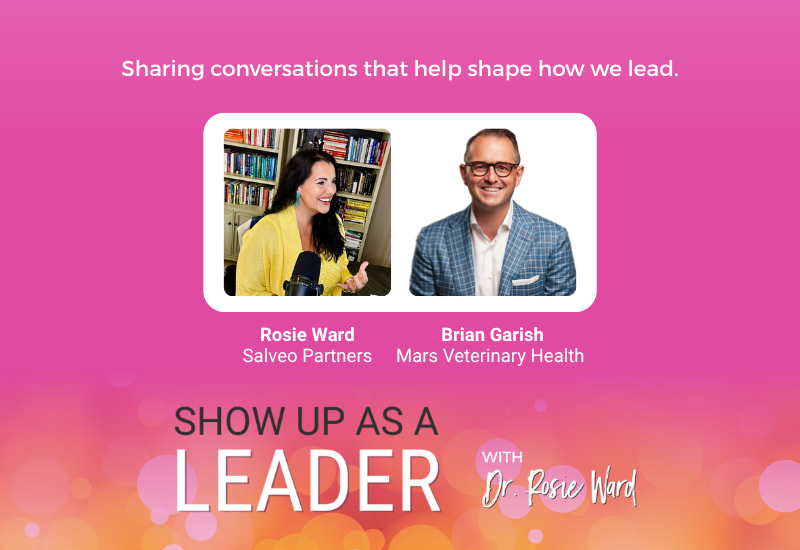
Some conversations remind me what leadership can look like when humility, courage, accountability, and sincere care all live in the same person.
That’s what I kept thinking during my conversation with Brian Garish.
Brian is now the Global Chief Client Officer at Mars Veterinary Health. When we first met a few years ago, he was serving as President of Banfield Pet Hospital, and I had the joy of working with some of his leaders during the pandemic. Since then, his scope has grown significantly. We’re talking global reach, clinics in more than 20 countries, and around 70,000 associates.
What stands out most about Brian isn’t the size of the organization.
It’s how grounded he is.
His humility.
His deep resolve to stay connected to the people closest to the work.
His belief is that, no matter what business we think we’re in, we’re really in the people business.
That line has stayed with me.
Because it’s true.
You may be in veterinary medicine, technology, education, healthcare, manufacturing, consulting, or something else entirely. But at the end of the day, people are serving people, caring for people, and trying to offer to something bigger than themselves.
Leadership is about creating the conditions for them to do that well.
Stay Close to the People Closest to the Work
One thing I love about Brian’s leadership is how intentionally he remains anchored in the reality of the front lines.
He started working at 16, stocking shelves, sweeping floors, and cashiering at Walgreens. That early experience demonstrated to him the importance of customer service.
That lesson never left him.
Even now, in a global leadership role, Brian keeps coming back to the same question:
Who are we actually here to serve?
For Mars Veterinary Health, that means pets, the associates who care for them, and the clients who love them. And if leaders lose connection to the people actually delivering that care, strategy becomes disconnected from reality.
I see this all the time.
A small group of senior leaders goes offsite to build a strategy. They use all the right words. They create the slide deck. They roll out the plan.
And then they wonder why it falls flat.
But if the people expected to bring that strategy to life don’t feel connected to it, hear it, or feel supported by it, even the best strategy will struggle.
Change management tools matter.
Communication plans matter.
But if we don’t care for how humans show up in the face of change, we miss the point.
Brian’s approach is beautifully simple: go visit people. Spend time with them. Ask what’s working and what isn’t. Listen for the stated and unstated concerns. Pay attention to what people are actually experiencing, not just what the dashboard says.
That isn’t ceremonial leadership.
That’s human leadership.
Culture Is Experienced Locally
Brian said something every senior leader needs to remember:
No matter what you want your company culture to be, people experience culture locally.
They experience it in their clinic, store, plant, department, team, meeting, one-on-one, and routine interactions.
Culture is not what’s written on the wall.
It’s not the polished language on the website.
It’s not the values slide in the onboarding deck.
Culture is what people experience.
- Do they feel noticed?
- Do they feel appreciated?
- Do they feel understood?
- Do they have the tools and resources to do their best work?
- Do they trust that leaders understand what their day-to-day reality is actually like?
- Do they feel connected to the purpose, or like cogs in a machine?
Brian talked about visiting clinics in a way that isn’t about the most senior person doing all the talking. In fact, earlier in his career, he noticed that when senior leaders visited a location, the senior person frequently dominated the conversation.
But a visit isn’t for the senior leader to perform leadership.
- It’s an opportunity to listen.
- It’s a chance to get close to clients, associates, and the real work.
- It’s a chance to understand what helps people thrive and what gets in their way.
That distinction matters.
Because when leaders show up only to talk, inspect, or maintain their own agenda, they miss the gift of what people are trying to tell them.
But when leaders show up with humility, curiosity, and a true desire to understand, people will tell them everything.
- The good.
- The hard.
- The hopeful.
- The broken.
The things that could unlock better performance if someone would just slow down long enough to listen.
Listening Is Not Enough Without Follow-Up
One of the most practical takeaways from Brian was this: great leaders listen, and then they follow up.
That second part is where many leaders lose trust.
People don’t just need to be heard in the moment. They need to know that what they shared mattered enough to be remembered, considered, acted on, or at least acknowledged.
We’ve all seen the opposite.
A leader holds a listening session. People open up. They share honest feedback. They take a risk.
Then nothing happens.
- No follow-up.
- No clarity.
- No visible action.
- No recognition of what was heard.
And what do people learn?
- Speaking up doesn’t matter.
- Feedback disappears into emptiness.
- Leadership may say it wants transparency, but the system isn’t actually built to respond to it.
That’s why listening has to be paired with action, communication, and accountability.
- Sometimes follow-up means fixing something.
- Sometimes it means explaining why something can’t change right now.
- Sometimes it means amplifying what’s working.
- Sometimes it means going back to leaders and saying, “Here’s what I heard, and here’s what we need to pay attention to.”
When leaders listen and consistently follow up, trust grows.
And trust is the foundation for everything else.
We Need Leaders Who Serve, Not Leaders Who Perform
Brian’s approach reminded me of Simon Sinek’s framing that weaker leaders talk about how many people report to them, while stronger leaders talk about how many people they have the privilege of serving.
That upside-down pyramid is more than a nice idea.
It’s a fundamentally different orientation to leadership.
If you believe people exist to serve your title, your agenda, or your ego, you will lead one way.
If you believe your role is to serve the people doing the work, you will lead in an entirely different way.
Brian talked about the responsibility leaders have to create the right environment for people to do what they do best. In his world, that means establishing a space where associates can make a better world for pets.
In your world, it may look different.
But the leadership question is the same:
Am I creating the conditions for people to contribute, grow, and do meaningful work?
Or am I getting in their way?
That question requires humility.
It requires self-awareness.
And it requires us to pay attention not only to what gets done, but how it gets done.
The “How” Matters as Much as the “What”
Brian and I kept coming back to accountability.
And here’s where we have to get honest.
Many organizations reward the “what” while ignoring the “how.”
They celebrate the numbers, the growth, the productivity, the output, the sale, the win.
But if someone delivers results while leaving damage in their wake, that isn’t leadership.
It’s extraction.
And eventually, the cost shows up.
- Burnout.
- Turnover.
- Disengagement.
- Resentment.
- Safety issues.
- Loss of trust.
High performers are leaving because they’re tired of bearing the burden.
Brian referenced a powerful idea from his own leadership learning: when leaders tolerate C players, they risk losing their A players.
Ouch!
That is so important.
Because your highest contributors are watching.
- They’re watching what gets tolerated.
- They’re watching whether leaders address behavior that hurts the team.
- They’re watching whether standards actually mean anything.
- They’re watching whether accountability applies to everyone or only to some people.
And when leaders avoid addressing poor performance or harmful behavior, the message is clear: we are willing to sacrifice the team’s health to avoid discomfort.
- That’s not kindness.
- That’s not care.
- That’s not human-centered leadership.
- That’s avoidance.
Yes, people deserve development, support, clarity, and a fair opportunity to improve.
And if someone consistently cannot or will not lead, collaborate, or contribute in keeping with the organization’s values and expectations, leaders must be willing to make the hard call.
Tolerating dysfunction is not neutral.
It harms the people who are trying to do the work well.
Guardrails Create Ownership
One thing Brian shared that I love is the significance of clear guardrails.
The best leaders in his career didn’t hand him a fully baked plan and tell him exactly how to execute it. They were clear on the outcomes that mattered, and then they gave him space to determine how to get there.
That is such a powerful leadership practice.
Because when leaders over-direct, they rob people of ownership, creativity, problem-solving, and growth.
But when leaders provide clear expectations, support, coaching, and guardrails, people get to build real capability. They get to think. They get to align with others. They get to create the plan. They get to learn from what works and what doesn’t.
And accountability feels healthier.
Instead of “you failed to execute my plan,” the conversation becomes, “Let’s look at the plan you created, what you committed to, what worked, what didn’t, and what needs to happen next.” That holds the focus on learning, ownership, and follow-through.
That’s adult-to-adult leadership.
- It’s not rescuing.
- It’s not micromanaging.
- It’s not abandoning people to figure everything out on their own.
It’s providing enough structure for clarity and enough space for ownership.
Values Have to Become a Playbook
Brian talked about Mars’ Five Principles, including responsibility and mutuality. What I appreciated was how he connected those principles to real leadership behavior.
That is what values are supposed to do.
Values should help people make decisions.
They should shape how we approach tension, tradeoffs, and uncertainty.
They should become a filter for how work gets done.
There’s a quote from Roy Disney that says,
It’s easy to make decisions when you know what your values are.”
I love that.
But here’s the thing: it’s only easier to make decisions from your values when those values have been translated into behavior.
If your values are generic words on a wall, everyone will interpret them differently.
- Respect.
- Integrity.
- Excellence.
- Care.
- Collaboration.
Those are lovely words. But what do they mean here?
What do they look like in action?
What behaviors are expected?
What behaviors are not okay?
How do they show up in hiring, feedback, meetings, promotions, client service, accountability, and conflict?
If we want values to shape culture, we have to make them concrete.
Otherwise, they’re just aspirations.
Pace Without Alignment Does Not Create Impact
One of the most vulnerable and useful parts of my conversation with Brian was when he shared a leadership lesson from earlier in his career.
He was driving hard. Moving fast. Setting the pace. Pushing action and activity.
And in some ways, the immediacy made sense.
But then one of his leaders gave him a gift.
She told him, “Give us time.”
She helped him see that while he was moving quickly, the team needed time to organize their people, communicate clearly, build understanding, and turn ideas into behavior. What seemed like a reasonable pace from his seat did not match the reality of the people responsible for implementation.
That feedback changed him.
He realized he had lost perspective on what it actually takes to cascade information, align teams, and make new behaviors stick.
That one hit close to home.
Because I can do this too.
My team will tell you that I am not always great at estimating how long things take. I can think something is a two-week project, and they look at me like I have four heads because it is actually a six-month project.
But that’s why we need people around us who can tell us the truth.
That’s why leaders have to ask.
That’s why we have to create enough psychological safety for someone to say, “The pace isn’t working.”
Pace without alignment doesn’t create impact.
- It creates activity.
- It creates overwhelm.
- It creates rework.
And it often burns out the very people we’re depending on to bring the strategy to life.
We Are Emotional Creatures
Another part of the conversation I deeply appreciated was Brian’s honesty about his own inner work.
He talked about learning to recognize when he was personalizing something, creating a story, or assuming negative intent. He named how easy it can be to get pulled into an unhelpful narrative when he doesn’t feel supported or when a situation triggers defensiveness.
That’s human.
We all do this.
Our brains are meaning-making machines. When we don’t have the full story, we fill in the gaps. And often, especially under stress, we fill them in with fear, self-protection, or old patterns.
This is why self-awareness is not optional for leadership.
It’s THE work.
Because the more disruptive, uncertain, and complex the world becomes, the more our self-protective wiring gets activated. We may think we’re responding as mature, wise adults, but often our younger selves are driving the bus.
That’s why I talk so much about faulty programs.
These old patterns can hijack how we lead, listen, react, hold people accountable, and interpret what’s happening around us.
Brian said something so important: we can’t use logic and reason to fix an emotional situation.
Yes!
We like to believe we are logical, rational beings.
But we are emotional creatures.
If we don’t build emotional consciousness, emotional literacy, and the capacity to regulate ourselves under pressure, all the leadership tools in the world will only get us so far.
Because leadership isn’t simply about knowing what to do.
It’s about being able to access the best of who we are when it matters most.
The Bottom Line: Get Close to Your People
Near the end of our conversation, I asked Brian what one behavior he would challenge leaders everywhere to practice to create more human workplaces.
His answer was simple and powerful:
Get closest to your people and develop better listening routines at scale.
I love that.
Because so many leadership challenges don’t require leaders to guess better.
They require leaders to listen better.
If something isn’t working, don’t automatically create a new strategy.
Talk to your people.
If engagement is low, talk to your people.
If a change initiative is stalling, talk to your people.
If clients or customers are frustrated, talk to the people closest to them.
If culture feels misaligned, talk to the people experiencing it.
And then listen.
Really listen.
Not to defend.
Not to explain.
Not to cause concern.
Listen to understand what’s actually happening.
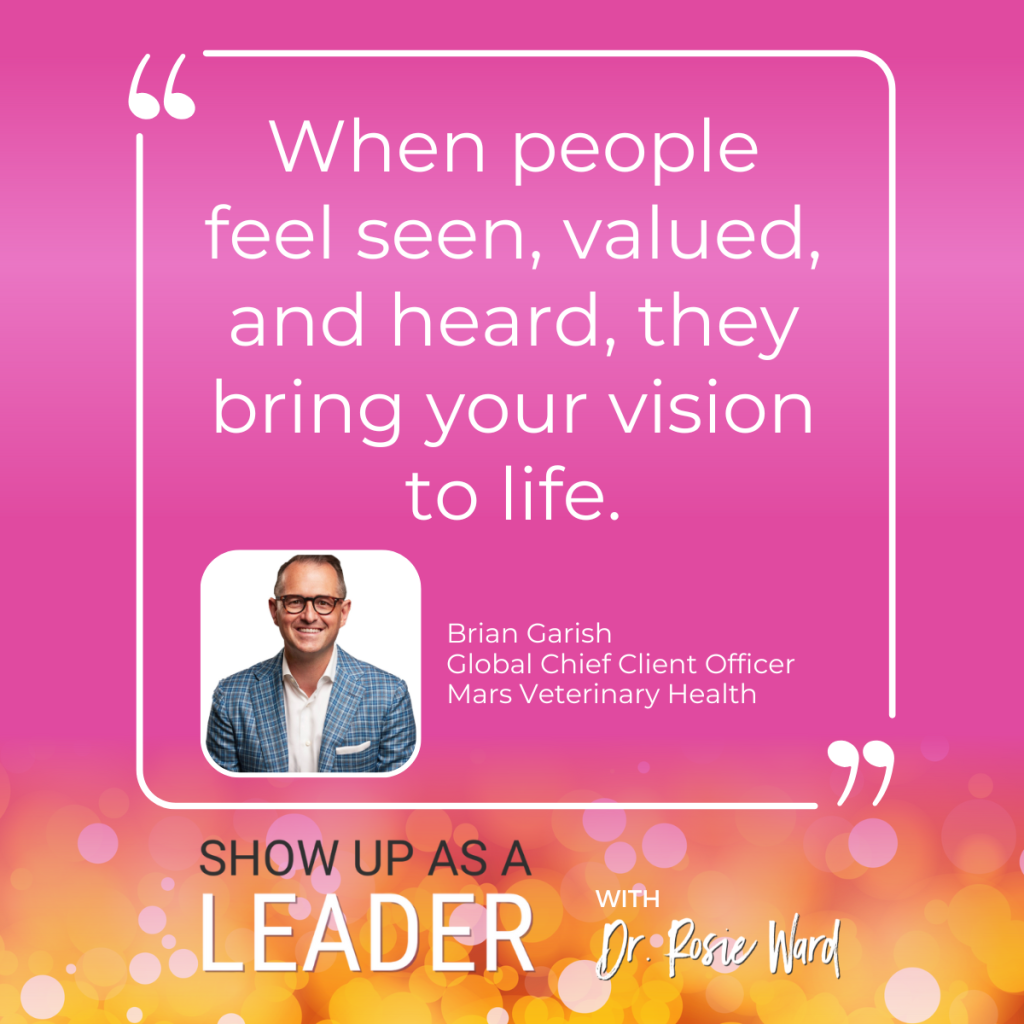
Because when people feel seen, valued, heard, and supported, they are far more likely to bring their gifts, energy, creativity, and care to the work.
And when leaders stay close enough to understand what their people are experiencing, they can create cultures in which strategy becomes human, values become behavior, accountability becomes care, and work becomes a place where people can actually thrive.
One Challenge For You
This week, practice getting closer to your people.
Choose one person, team, or group whose day-to-day reality you need to understand better.
Ask three questions:
- What’s working well right now?
- What’s getting in your way?
- What’s one thing I may not fully understand about your experience?
Then do the hardest and most important part.
Listen.
Don’t defend. Don’t explain. Don’t solve too quickly.
Listen for both the stated and unstated concerns. Pay attention to what energizes them and what drains them.
And then follow up.
Because listening without follow-up could diminish trust.
Listening with care, clarity, and action can rebuild it.
Want to go deeper?
This article only scratches the surface of my conversation with Brian.
In the full episode, we talk about what it means to lead with humility inside a large global organization, how to stay connected to the people closest to the work, why accountability is essential for healthy cultures, and how leaders can continue doing their own inner work so old stories and self-protective patterns don’t run the show.
Brian delivers practical wisdom for any leader who wants to create a culture where people feel noticed, valued, heard, and equipped to do meaningful work.
I invite you to listen to the full episode of Leading with Heart at Global Scale.
A Clear Next Step
If this conversation has you thinking about how your leaders show up, how your culture is experienced, or whether your values are truly being lived, Salveo Partners can help.
Our coaching, leadership development, and culture transformation work helps leaders build the self-awareness, courage, emotional agility, and human-centered practices needed to lead in today’s complex world.
And if you want an immediate place to begin, I invite you to get my book, Future-Proofing Leadership. Inside, you’ll gain access to the Faulty Program Discovery, a tool to help you uncover what might be getting in your way as a leader. You’ll also find free resources with every chapter to help you put the concepts into practice.
Future-proofing leadership is not about having all the answers.
It’s about becoming the kind of leader who stays grounded, listens deeply, builds trust, holds people accountable with care, and creates the conditions where humans can do their best work.
If you’re ready to transform how you lead, Salveo Partners can help.
👉 Learn more about Leader Coaching with Salveo Partners.
👉 Get your copy of Future-Proofing Leadership.

